Enrol your child on our brand new private Study Skills Workshop‼️
The Tuition Club is pleased to introduce a new Study Skills Workshop every Tuesday 11.30 – 1pm. The private sessions will aim to help home schooled children in organising their studies, it will teach them how to manage their learning by studying effectively; which will include creating schedules, implementing ways to improve concentration, memory skills and organisation.
Alhamdulillaah yesterday afternoon we came to the end of the winter term 2018 at the Tuition Club and to celebrate the achievements of our home schooled students, we held an end of term ceremony and a parents afternoon.
During the ceremony our students were rewarded for achieving a 100% mark in all subjects on the Tuition Club behaviour and effort charts, and were presented with certificates and gifts.
Some of our Arabic students also gave a presentation and spoke about the environment. They spoke about the different ways we can protect the environment from pollution. Also, we had some lovely speeches from some of our home-schooled children.
After the ceremony we held a parents afternoon, which gave parents the opportunity to speak to the tutors regarding their child’s progress.
Alhamdulillaah a lovely afternoon was had by all, and the ceremony was a befitting end to a fantastic term.
We would like to thank all parents for their continued support, and tutors and students for all their hard work and effort.
We hope you all have a lovely winter break, and we look forward to our students returning on Wednesday 3rd January 2019 in shaa Allaah.
As we are coming towards the end of term, children have been revisiting topics of Ecology and Plant Nutrition/respiration in plants as well as many other areas.
Display posters were created which involved diagrams and pictures showing the part that flowers play in the life cycle of flowering plants.
By the end, the children were able to demonstrate understanding of the process of seed dispersal, the processes of pollination, fertilisation and germination as well mention the different stages of the life cycle of a flowering plant.
Our home-schooled children have been working together to make a mini-ecosystem for earthworms, using a soda bottle and a little creativity.
As with all other organisms, earthworms occupy a certain niche: They are both decomposers and consumers, feeding on things like decomposing remains, manure, and other small underground organisms like nematodes, bacteria, fungi, and rotifers.
Earthworms breathe by coating themselves with mucus, which allows dissolved oxygen to pass into their bloodstream, so living conditions must be moist and humid, or else the worms will dry up. They are ecologically important because they loosen and mix up the soil, enabling water and nutrients to seep through to plant roots. Since they can’t walk, earthworms move with tiny bristles, or setae, which are paired on each of their segments and grip onto the worms’ tunnel walls. Then the worms push themselves forward with strong muscular contractions.
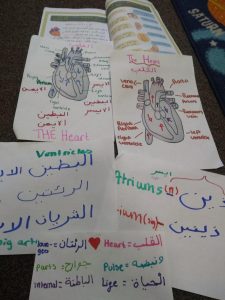
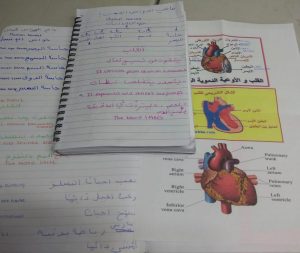
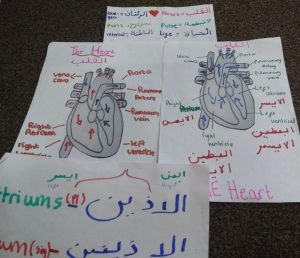
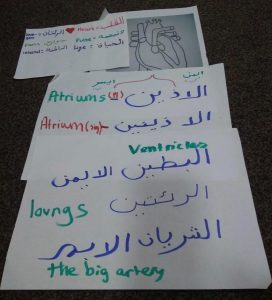
By studying the anatomy of a sheep’s heart, children learned about how our own heart pumps blood through your body and keeps us alive.
The experience of dissecting real animal material adds an extra dimension to understanding the structure of the heart and the relationship of structure to function.
The activity allowed the children to investigate and explore the texture and thickness of the vessel and chamber walls, and the movement of the different kind of valves.
Using handouts with pictures/diagrams the children could also see what was going on with the heart in different stages of the dissection.
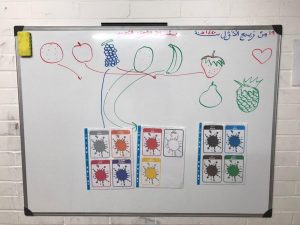
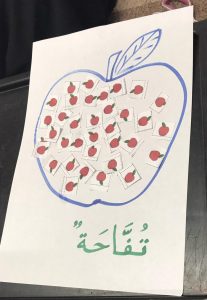
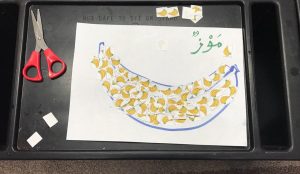
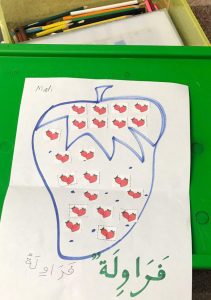
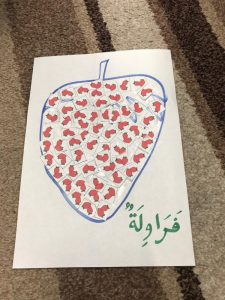
Following on from last week’s session on Tuesday, children at our Kids Arabic started linking the variety of fruits that they learned with associated colours.
Using the immersive language strategy, the tutor also supported the children to pronounce the names of the fruits and colours featuring key fruit images and vocabulary.
They also participated in a Fruit and Colours Matching Game which gave the children the chance to reinforce fine motor skills by working on the task challenge whereby the children cut out the fruit pictures and used them for the different games and activities.
This gave the children the opportunity to show how much they’ve learned about this topic.
During History, Key Stage 1 children have been learning about Ancient Egyptian Jewellery.
During this time, Jewellers were skilled craftsmen.
The jewellery was beautiful and colourful, and was made out of copper and gold wire, gemstones, coloured glass beads, and colourfully painted clay beads.
Wide collars were popular, as were rings, earrings, and bracelets worn at the wrist, upper arm and around the ankle.